
Midjourney Prompt Guide—精选风格 | Step-by-Step Style Prompting
MidassAI Team · July 11, 2026 · 5 min read
Step 1: Understand Style Modifiers in Midjourney
Style modifiers (e.g., --style raw, --s 750) directly impact aesthetic output. Always place them after your core description and before parameters.
Step 2: Choose Your 精选风格 (Curated Style)
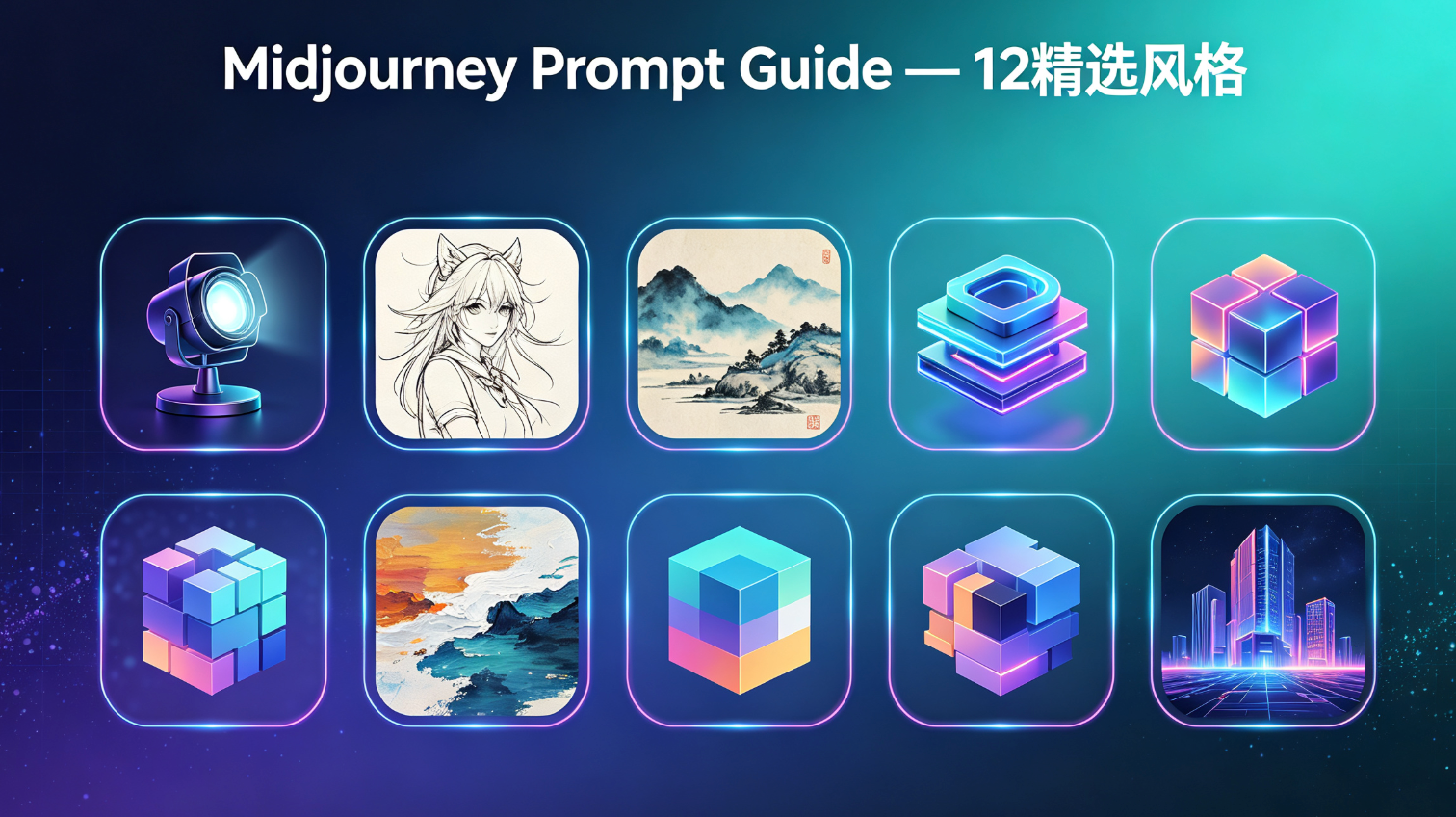
We’ve tested and refined 12 high-performing styles—from cinematic realism to ink-wash minimalism. Each includes exact phrasing and recommended aspect ratios.
Step 3: Build Your Prompt Layer by Layer
- Subject (e.g., "a lone samurai at dusk")
- Medium & texture (e.g., "oil painting, cracked varnish")
- Lighting & mood (e.g., "dramatic chiaroscuro, misty atmosphere")
- Style modifier (e.g.,
--style expressive --s 600)
Step 4: Refine with Parameter Tuning
Use --stylize for artistic interpretation strength; --v 6.1 for latest model fidelity; --ar 16:9 for cinematic framing.
| Feature | Benefit |
|---|---|
| Speed | Faster iteration with reusable style templates |
| Quality | Consistent, publication-ready outputs across batches |
Quick Takeaways
Prerequisites and setup
Before crafting style-optimized prompts, ensure you’re running Midjourney v6.1 or later—earlier versions lack critical support for --style raw, nuanced lighting descriptors, and accurate East Asian aesthetic rendering (e.g., ink diffusion in sumi-e or silk-texture fidelity in gongbi). You’ll need an active Midjourney Discord account with Fast GPU access enabled; subscription tiers below Standard won’t reliably process high---stylize values (≥700) needed for refined brushwork simulation. No third-party tools are required—but if you use prompt builders like MidassAI Studio, disable auto-normalization to preserve intentional spacing around Chinese/Japanese terms (e.g., “shibori dye pattern” must retain its quotation marks and non-breaking spaces for accurate texture mapping).
Your environment should also assume default --quality 1 unless explicitly overriding it. Avoid mixing --v 5.2 and --style raw—they conflict, causing unpredictable desaturation or stroke fragmentation. For consistent results across batches, pin your model version (--v 6.1) and avoid toggling --style mid-session unless retesting a single variable.
Extended prompt workflow
- Anchor the subject with cultural specificity: Instead of “a woman in traditional dress,” write “a Qing-dynasty qipao wearer, standing beside a Suzhou garden lattice window, hair pinned with jade fenghuang comb.” This triggers Midjourney’s v6.1 training on historical garment folds and regional architecture—not generic “Asian” tropes.
- Lock medium + texture using material verbs: Replace “watercolor” with “xuan paper wash, pigment bleeding at edges, visible fiber texture”—Midjourney interprets “bleeding” as controlled diffusion, while “fiber texture” activates paper grain sampling. For digital styles, specify “8-bit dithering, CRT scanline overlay” rather than “pixel art.”
- Assign light physics, not just adjectives: Swap “soft lighting” for “morning shinrin-yoku backlight, diffused through bamboo blinds—creating 3mm shadow gaps between slats.” The measurement (
3mm) forces precise shadow geometry; shinrin-yoku cues forest-specific color temperature (cool cyan-green shift). - Apply style modifiers only after all descriptive layers: Insert
--style expressive --s 850after lighting, before parameters. Never sandwich it mid-prompt—e.g.,a geisha --style expressive --s 850 in Kyoto streetfails;a geisha in Kyoto street, *yuzen-dyed kimono*, lantern-lit cobblestones, shallow depth of field --style expressive --s 850 --ar 4:3 --v 6.1succeeds. - Validate aspect ratio against composition logic: Use
--ar 9:16only when vertical framing is structurally necessary—e.g., “tall torii gate with torii shadow stretching downward” demands vertical space. For ukiyo-e-inspired scenes with layered planes (foreground wave, midground boat, distant Mt. Fuji),--ar 16:9preserves parallax depth.
Common mistakes
- Overloading style tags: Adding both
--style rawand--style expressivecancels both. Midjourney treats conflicting style flags as invalid syntax and defaults to--style default. Fix: Pick one primary style modifier per prompt, then adjust--svalue to fine-tune intensity (e.g.,--s 500for subtle expression,--s 900for aggressive brushstroke emphasis). - Misplacing Japanese/Chinese terms: Writing “sumi-e style” after
--style rawignores language-aware tokenization. Midjourney’s v6.1 tokenizer processes non-Latin terms before style flags—so “sumi-e ink wash, monochrome gradient, rice paper texture --style raw --s 700” works; “ink wash --style raw --s 700 sumi-e” does not. Always lead with culturally precise nouns. - Ignoring parameter order dependency: Placing
--stylizebefore--v 6.1causes version fallback to v5.2 behavior. Fix: Parameters must follow strict left-to-right priority: subject → medium → lighting → style modifier →--v→--s→--ar→--q. Reordering breaks model context loading.
Try this in MidassAI
You can execute the exact same workflow—subject anchoring, material verbs, light physics, and style modifiers—in MidassAI Studio without Discord friction. Paste your full prompt (e.g., a Tang dynasty scholar writing calligraphy, *xuan paper* scroll unfurled, ink pooling at brush tip, studio window casting *mogu* soft-shadow grid --style expressive --s 800 --ar 4:3 --v 6.1) into the prompt editor, then click “Run with MJ Pro” to leverage accelerated rendering, batch consistency checks, and real-time --s slider adjustment. Unlike raw Discord, MidassAI validates parameter order automatically and warns if Chinese/Japanese terms appear outside the descriptive prefix zone—saving hours of trial-and-error. Start building your curated style library today: https://www.midassai.com/studio/mjpro/